

There are coincidences that, even when you know they are simply coincidences, arrive in your life with such perfect timing that you cannot help but stop and pay attention: Orixás, Odissi & sacred dance
My relationship with dance began long before India. My professional journey was deeply shaped by Afro-Cuban and Afro-Brazilian dance, and especially by everything I discovered through music, percussion, the body and traditions connected to the Orixás. I have travelled to Bahia three times, and each of those experiences left something behind in the way I understand and experience dance.

So, when I arrived in India and began discovering Odissi, something immediately caught my attention.
I was in a land that had historically been known as Kalinga, later Orissa, and is now called Odisha. And that name inevitably sounded familiar to me: Orixás.
I knew there was no etymological connection between Odisha and the Orixás. It was simply a coincidence. But it made me smile and, more importantly, it made me pay even closer attention to what I was discovering.
Because the more I learned about Odissi, the more I found elements that, from my own experience, felt strangely familiar.
Not because they were the same traditions. They are not. They come from different places, have different histories and belong to different cultural and religious worlds. But both spoke to something I already knew: dance as a way of relating to the sacred.
Through the Afro-Brazilian and Afro-Cuban traditions that had shaped my own journey, I had learned that rhythm, drums, movement and the body could be connected to the Orixás. The batá drum, for example, is not simply a musical instrument in certain ritual contexts; its rhythms form part of a language connected to the deities.
And in Odisha I discovered another world in which music, dance, spirituality and tradition were deeply intertwined.
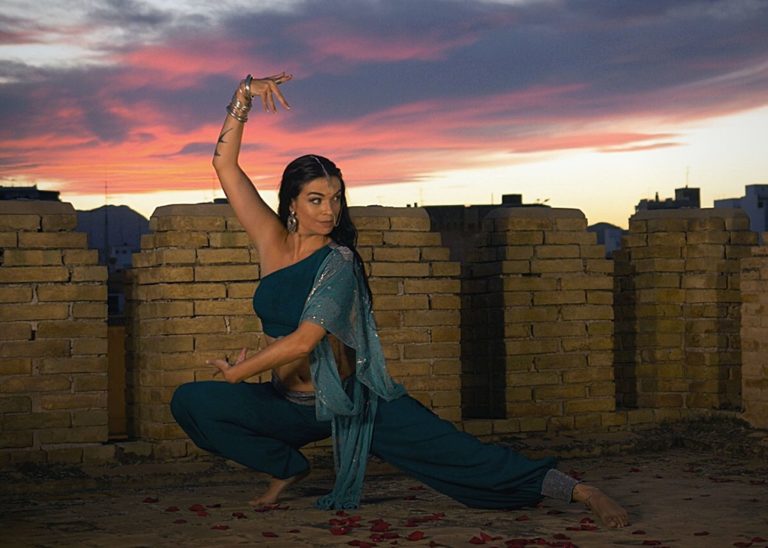
Odissi has a long history connected to the temples of Odisha and to devotion, particularly around the Jagannath Temple in Puri. The Mahari tradition, performed by women connected to the temple, forms part of the historical roots of the dance.
And then there was another detail that fascinated me: the mardala, the traditional percussion instrument associated with Odissi music.
I came from the batá.
Now I was discovering the mardala.
Two completely different instruments, belonging to completely different traditions, yet once again percussion was occupying a central place in my experience of dance.
And that was when I began to understand that perhaps what moved me was not finding exact similarities, but recognising a shared human impulse: using the body, rhythm, music and gesture to relate to something greater than ourselves.
It appears in very different ways across different cultures.
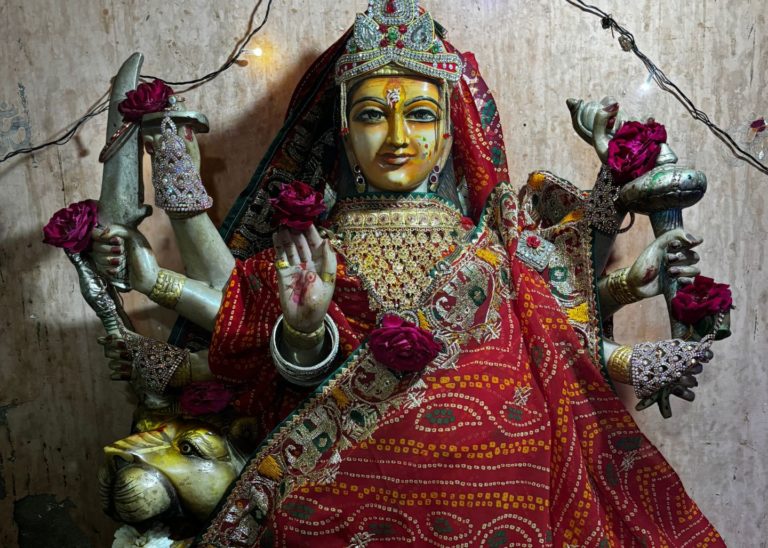
In some traditions, dance can accompany a ritual dedicated to an Orixá. In others, it can form part of a devotional tradition connected to a deity or a temple. The gestures, rhythms and forms may be different, but the idea that the body can become a vehicle for expressing something beyond ourselves is deeply powerful.
For me, discovering this was even more meaningful because it came after years of following different paths.
First came Afro-Cuban and Afro-Brazilian dance. Then India and Odissi. Later came Oriental dance, Kalbelia, contemporary dance, yoga and so many other influences that have shaped the way I move and create.
Today, when I look back, I understand that none of these experiences exist separately.
My body has been collecting languages.
And each one has taught me something different about rhythm, presence, expression, music and dance itself.
Perhaps that is why, when I discovered Odissi, there were things my mind had to learn, but that my body recognised much faster.
Not because the traditions were the same.
But because I already knew that dance could be much more than a sequence of movements.
It can be memory.
Identity.
Celebration.
Ritual.
A way of telling who we are and where we come from.
And it can also be a way of encountering something we do not yet know how to name.
I believe that an important part of my journey as a dancer and as the creator of IndOriental® comes from precisely this: allowing different languages to enter into dialogue within my body, without needing to erase the differences between them.
I am not trying to prove that Odissi and the dances connected to the Orixás are the same.
I am much more interested in asking what we can learn when we look at the ways different cultures have used the body to relate to the sacred.
And perhaps that is one of the reasons why I keep travelling, studying and dancing.
Because sometimes a coincidence, a name, a drum or a seemingly small movement can open a very large door.
For me, that door opened in India.
And I am still exploring everything that was behind it.